The Sailing Season Fitness Plan
Strength training fitted around the days you sail, counted back from your first race, and kept through the season
SailorFit's Workout Planner asks how many days a week you can train and never asks how many of them you spend on the water, and neither it nor the One-Rep Max Calculator knows when your season starts. A sailor who races twice a week and asks the planner for five days is handed seven hard days and no day off, and a build with no date peaks whenever it happens to. The Sailing Season Fitness Plan counts the sailing as training, keeps one full day off, and places the planner's own split so no lower-body session falls the day before a race and no region works two days running. In the worked example, a sailor racing Wednesday evenings and Saturdays fits 4 sessions, not 5. It then counts back from the first race: build weeks, every fourth an easy week, and race week, with loads for one main lift set from the lower of the calculator's two estimates and rounded down to a jump you can load. An 80 kg squat for 6 builds from 55 kg to 72.5 kg over 12 weeks; started 6 weeks out, it ends at 67.5 kg, and the plan says so instead of cramming. In season it keeps a third of the sets on two days. It is a training calendar for adults, with the HHS two-days-a-week guideline and a published maintenance study quoted; it says nothing about food or body weight, never tests a true maximum, and points to the US Coast Guard and the RNLI for boating safety. Every figure is an example to replace with your own. Included: a 24-page printable PDF with 7 steps, a week sheet, a season calendar, a load card, a session log, a start-and-peak reference table, a quickstart, and a personalised sheet worked from the numbers you enter in the Workout Planner and the One-Rep Max Calculator.
Look inside
Two full pages from the pack, exactly as printed. Click either to read it at full size before you decide.
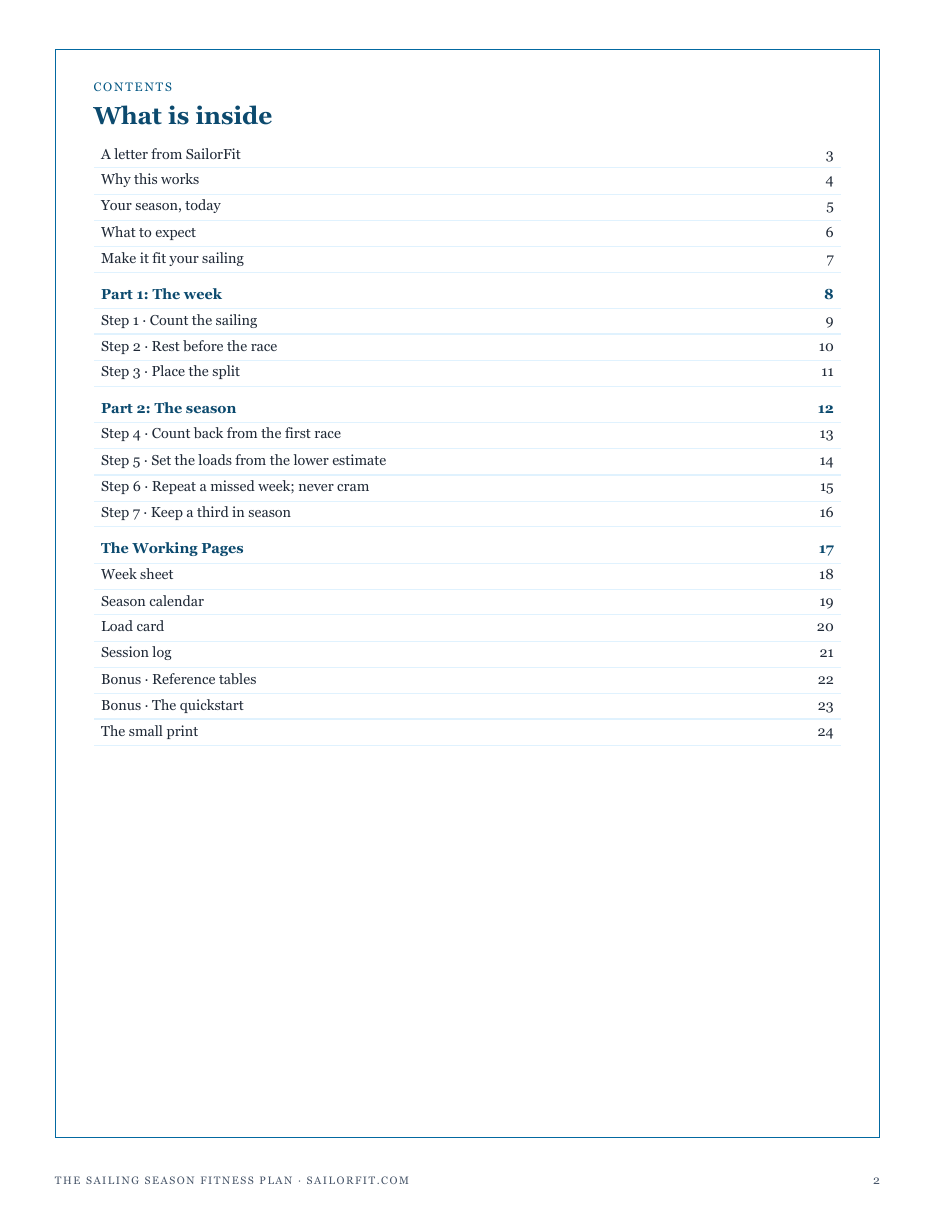
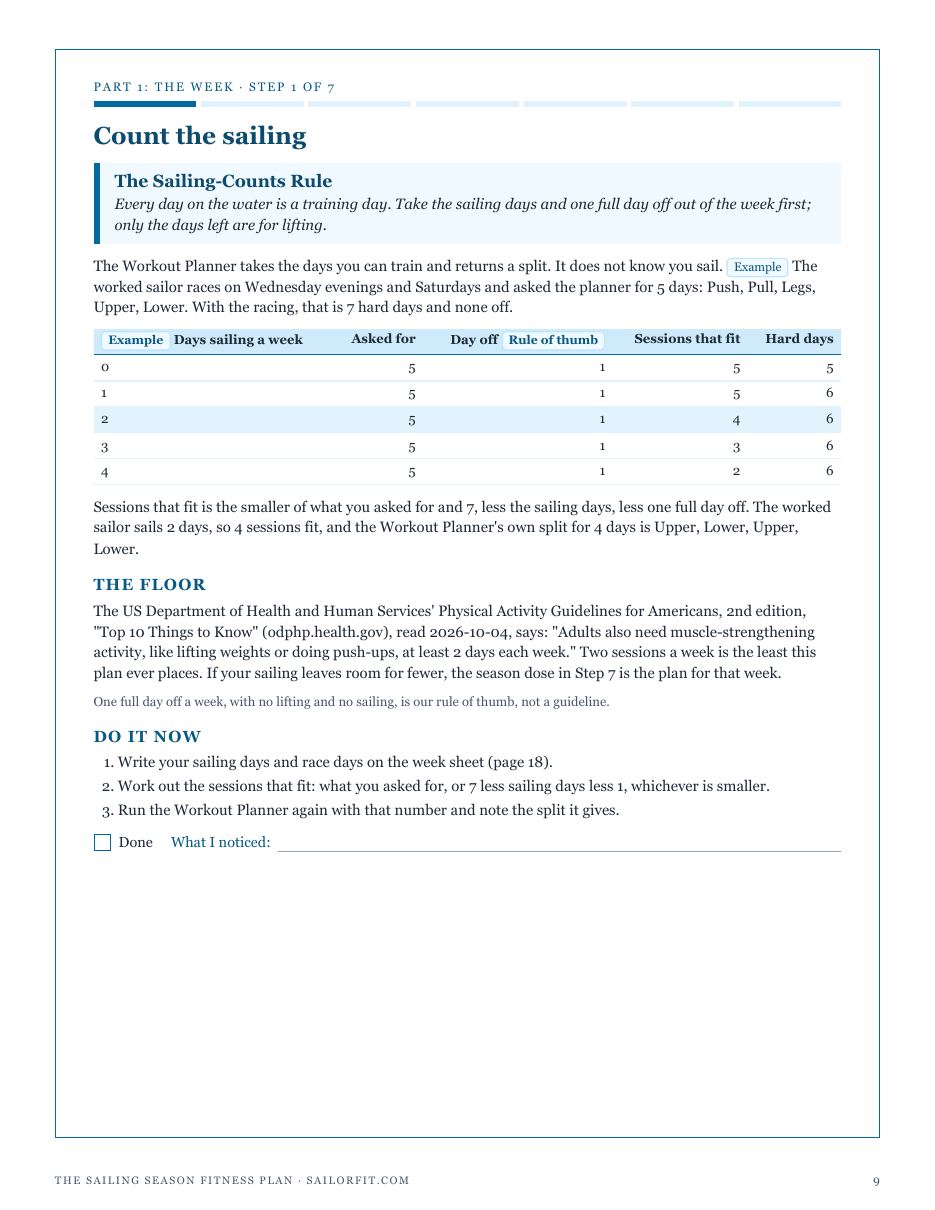
What is in it
- The Sailing-Counts Rule: days on the water count as training, with one full day off, and the sessions that fit
- The Fresh-Legs Rule: the day off before your main race, and no lower-body session the day before any race
- The No-Repeat Rule: the Workout Planner's split placed so no region works two days running
- The Count-Back Rule: build weeks, easy weeks and race week counted back from your first race
- The 80% Ceiling Rule: loads from the lower of the two estimates, rounded down, between the 60% and 80% rows
- The No-Cramming Rule: a missed week repeated, a late start ending lower, never two jumps in one week
- The One-Third Rule: a third of the sets on two days a week through the season, with the study quoted
- Working pages: week sheet, season calendar, load card and session log
- Reference tables: start and peak loads by estimate and weeks out, and sessions that fit by days sailing
- A one-page quickstart and a personalised sheet worked from your own calculator inputs
- ✓ 24 printable pages
- ✓ 10 sections, worksheets and templates
- ✓ A second PDF worked out from the numbers you enter
- ✓ No account needed, just an email address
- ✓ Instant download; link valid 7 days
Price includes any taxes. Sold by GrabURL, who handle checkout and support. The charge appears on your statement as GrabURL.
The pack picks up where the free Workout Plannerleaves off. That tool asks how many days a week you can train and never asks how many of them you spend on the water, so a sailor who races twice a week and asks for five days gets seven hard days and none off. The pack counts the sailing as training, keeps one full day off, and places the planner's own split so no lower-body session falls the day before a race. With the One-Rep Max Calculator it counts back from your first race and sets the weekly loads for one main lift from the lower of its two estimates, rounded down to a jump you can load, so the build peaks the week before racing; then it keeps a third of the work on two days a week through the season. It is a training calendar for adults: it says nothing about food or body weight, and it is not boating safety advice. Every figure in it is an example for you to replace with your own.